Experts said that although the work was still at an early stage, it was very exciting.
What have they found?
Our immune system is our body's natural defence against infection, but it also attacks cancerous cells.
The scientists were looking for "unconventional" and previously undiscovered ways the immune system naturally attacks tumours.
What they found was a T-cell inside people's blood. This is an immune cell that can scan the body to assess whether there is a threat that needs to be eliminated.
The difference is this one could attack a wide range of cancers.
"There's a chance here to treat every patient," researcher Prof Andrew Sewell told the BBC.
He added: "Previously nobody believed this could be possible.
"It raises the prospect of a 'one-size-fits-all' cancer treatment, a single type of T-cell that could be capable of destroying many different types of cancers across the population."
How does it work?
T-cells have "receptors" on their surface that allow them to "see" at a chemical level.
The Cardiff team discovered a T-cell and its receptor that could find and kill a wide range of cancerous cells in the lab including lung, skin, blood, colon, breast, bone, prostate, ovarian, kidney and cervical cancer cells.
Crucially, it left normal tissues untouched.
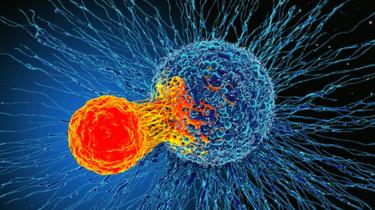
Image copyrightSCIENCE PHOTO LIBRARYImage captionT-cells attack cancer cells
Exactly how it does this is still being explored.
This particular T-cell receptor interacts with a molecule called MR1, which is on the surface of every cell in the human body.
It is thought MR1 is flagging the distorted metabolism going on inside a cancerous cell to the immune system.
"We are the first to describe a T-cell that finds MR1 in cancer cells - that hasn't been done before, this is the first of its kind," research fellow Garry Dolton told the BBC.
Why is this significant?
T-cell cancer therapies already exist and the development of cancer immunotherapy has been one of the most exciting advances in the field.
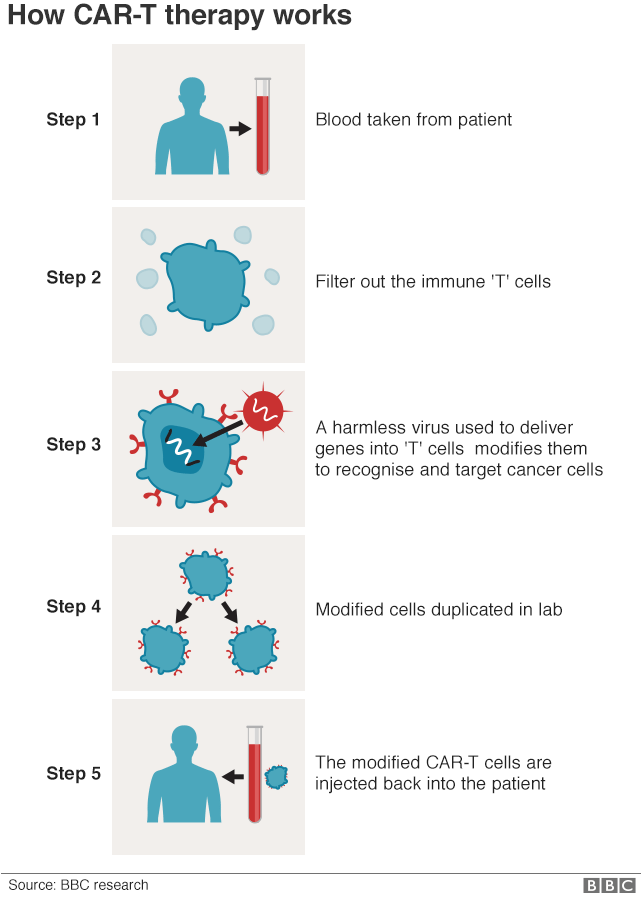
The most famous example is CAR-T - a living drug made by genetically engineering a patient's T-cells to seek out and destroy cancer.
CAR-T can have dramatic results that transform some patients from being terminally ill to being in complete remission.
However, the approach is highly specific and works in only a limited number of cancers where there is a clear target to train the T-cells to spot.
And it has struggled to have any success in "solid cancers" - those that form tumours rather than blood cancers such as leukaemia.
The researchers say their T-cell receptor could lead to a "universal" cancer treatment.
So how would it work in practice?
The idea is that a blood sample would be taken from a cancer patient.
Their T-cells would be extracted and then genetically modified so they were reprogrammed to make the cancer-finding receptor.
The upgraded cells would be grown in vast quantities in the laboratory and then put back into the patient. It is the same process used to make CAR-T therapies.
However, the research has been tested only in animals and on cells in the laboratory, and more safety checks would be needed before human trials could start.
What do the experts say?
Lucia Mori and Gennaro De Libero, from University of Basel in Switzerland, said the research had "great potential" but was at too early a stage to say it would work in all cancers.
"We are very excited about the immunological functions of this new T-cell population and the potential use of their TCRs in tumour cell therapy," they said.
Daniel Davis, a professor of immunology at the University of Manchester, said: "At the moment, this is very basic research and not close to actual medicines for patients.
"There is no question that it's a very exciting discovery, both for advancing our basic knowledge about the immune system and for the possibility of future new medicines."
By Suleiman Ugbokhe Pa Akubo Yakubu Esuka, the Ódegbé of Imiegba Imiegba Community, Three Ivie Clan in Etsako East local government area was in a celebration mode on Sunday, December 27, 2020, when the indigenes both home and abroad joined the children of Pa Akubo Yakubu Esuka to celebrate his enthronement as the Ódegbé of Imiegba. Pa. Akubo Yakubu Esuka was born to the family of Mr. Esuka and Madam Ogenikho about 104 years ago in Imiegba. In his quest for a better life, he left his birth place, Imiegba, in 1944, with his maternal uncle, Pa Etsekhumhe Ogweli for Minna where he did manial jobs for some time before he left for Kaduna with a single mission: To join the army. But it turned out to be mission impossible as Pa Akubo was not accepted into the army "for reasons I don't know," he says. "I then proceeded to Kano from Kaduna with the hope of securing a job. I was still not able to get a job." As the saying goes, 'no place like home,' Pa Akubo had ...
Image copyright ESTHER HORVATH Image caption RV Polarstern (left), aided by the Russian icebreaker Akademik Fedorov, has found the right floe German Research Vessel Polarstern has found a location to begin its year-long drift in Arctic sea-ice. The ship, which will head the North Pole's biggest scientific expedition, will settle next to a thick ice floe on the Siberian side of the ocean basin. The precise location is 85 degrees north and 137 degrees east. Hundreds of investigators will use it as a base from which to probe the impacts of climate change at the top of the world. "After a brief but intensive search, we've found our home for the months to come," said expedition leader Prof Markus Rex, from the Alfred Wegener Institute (AWI). "It may not be the perfect floe but it's the best one in this part of the Arctic and offers better working conditions than we could have expected after a warm Arctic summer." Image copyright...
Image copyright REUTERS Image caption Members of a right-wing group bow their heads to honour the war dead at the shrine The chief priest at Japan's controversial Yasukuni Shrine is to resign after making remarks highly critical of Emperor Akihito. In comments leaked to a magazine, Kunio Kohori said he believed Emperor Akihito was trying to destroy the shrine by not visiting it. The shrine in Tokyo honours Japan's 2.5 million war dead but also enshrines convicted criminals of World War Two. It remains a high source of tension with neighbours, particularly China. Emperor Akihito, who will abdicate next year, has never visited the shrine. He has instead sought reconciliation with Japan's wartime enemies. He has expressed regret over Japan's military actions in both China and the Korean peninsula, and has also visited several Pacific battlefields to honour the dead, actions that have brought him into conflict with right-wing groups at home. Kunio Kohori'...
 SCIENCE PHOTO LIBRARY
 SCIENCE PHOTO LIBRARY


Comments